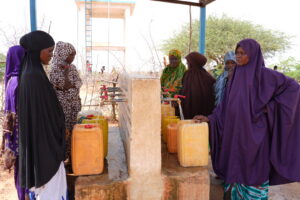
Amino fetching water at the water kiosk close to her home together with her neighbours.
In Gondobow, a solar-powered water system now serves displaced families and host households side by side, bringing safe water, healthier children, and more time for productive work.
For Amino Muqtar Mohamed, a mother living in Gondobow village in Dolow District, in the Gedo region of Somalia, fetching water was once a daily struggle that shaped her family’s health and her own time.
Dolow sits on Somalia’s border with Ethiopia, where the Dawa and Ganale rivers meet to form the Juba. Repeated droughts, floods, and insecurity have brought tens of thousands of displaced people into the district, and villages such as Gondobow now share their land, their markets, and their water with families who arrived with very little. When water is scarce, the pressure falls hardest on women and children.
“Before we received this water supply, our situation was very difficult,” Amino recalls. “We used to spend a long time fetching water, sometimes up to half an hour or an hour. We also had to use a donkey to bring water from distant places.”
Each of those trips covered only part of the day’s needs. A donkey can carry just a few jerrycans, so the journey had to be repeated three times a day, in heat that often passes 35°C. On other days, the only option was the river. For riverside households in Dolow, that means climbing down steep, muddy banks to collect raw, untreated water.
Even after all that effort, there was rarely enough water for the household, and what Amino carried home was often dirty. With no proper way to treat it, the best she could do was boil it before giving it to her children. It was not always enough.
“The water we used before was dirty and contaminated. It was not clean or safe for drinking,” Amino says. “Because of this, our children frequently suffered from illnesses, including fever and diarrhoea.”
Untreated river water is one of the main routes for acute watery diarrhoea and cholera, which return across Gedo with drought and flooding and are most dangerous for young children. For families in Gondobow, unsafe water meant sick children, worried parents and the constant risk of an outbreak.
Water from the River, Powered by the Sun
That changed in September 2026. Under the Enhancing Access to WASH Services for IDP and Host Community project, the Nomadic Assistance for Peace and Development (NAPAD), with funding from Norway and Norwegian Church Aid (NCA), in coordination with the Jubaland State Ministry of Energy and Water Resources, built a complete water system for the village.
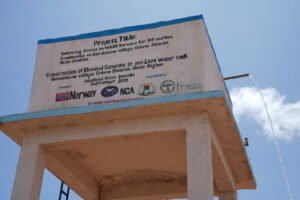
20,000L elevated concrete water tank in Gondobow village
A new shallow well on the riverbank is pumped by solar power, so it runs without the fuel costs of a diesel generator. The water travels through 1.2 kilometres of pipeline to an elevated concrete tank that holds 20,000 litres, and from there to a new water kiosk with eight taps. The kiosk now serves 80 households, about 200 people, from both the displaced and the host communities of Gondobow.
That shared access matters. Across Dolow, competition over water points is a frequent source of friction between displaced families and the communities that host them. By serving both from one reliable source, the kiosk is designed to take that competition away, turning a potential flashpoint into an asset the whole village depends on.
Amino still remembers the day she first saw clean water flowing close to home. “I was extremely happy when I saw clean water becoming available to our community. It brought us great joy and relief,” she says. “As a mother, I was particularly pleased, because having clean water close to our homes has made our lives easier.”
Time for the Farm, Time for the Family
The hours Amino once spent walking, waiting, and hauling water are now hers to use. “Now that water is available nearby, I use the time I previously spent collecting water to work on my farm and carry out other productive activities,” she explains.
In the riverine farmland around Dolow, that time turns directly into food. Hours once lost to water can go into the family plot, where households grow maize, onions, and tomatoes, into selling surplus at the market, and into less dependence on relief food. Water close to home is, in practice, a gain for household food security.
Inside her home, the change is just as visible. With water close at hand, she now has time to bathe her children regularly, wash their clothes and keep the household clean. Today, Amino describes her children as clean and healthy, and her family as much cleaner than before.
Run by the Community
To keep the system working long after construction ended, NAPAD trained a Water Management Committee (WMC) for Gondobow, made up of five members, three of them women, drawn from the displaced and host communities. The committee runs the pump and kiosk, collects user fees, arranges repairs and monitors water quality. A complaints and feedback number is painted on the signboard and on the water tank, so any user can report a problem directly.
Amino’s own message is for other mothers. “I would advise other women who have not yet had the opportunity to benefit from clean water to make good use of it whenever they have access,” she says. “They should use it to bathe their children, keep their homes clean, and practise good personal hygiene.”
For Amino and her neighbours in Gondobow, displaced and host families alike, clean water close to home has meant fewer worries about sickness, more time for work and family, and children who are growing up healthier than before.