When violent conflict broke out in Belet-Hawa, in Somalia’s Gedo region, Dahabo Jimcale had no choice but to flee. With six children to protect, she left behind everything she knew, including the small home she had built and her job at the local market, that enabled her to put food on the table. Before the conflict, Dahabo worked long days as a casual labourer in the town’s market. Dahabo is one of thousands of families displaced by the ongoing conflict in Gedo. Deep political tensions, competition over scarce resources, and unresolved historical grievances have displaced more than 250,000 people across Gedo, Lower Juba, and Shabelle regions.
The humanitarian impact of these conflicts is severe, leading to large-scale displacement, food insecurity, and limited access to essential services especially among the women, children and people with disabilities. Families like Dahabo’s now face hunger, lack access to clean water, and have limited access to healthcare, shelter, and livelihood opportunities. For many, each new day is a struggle not just to survive, but to hold on to hope that peace will return soon.
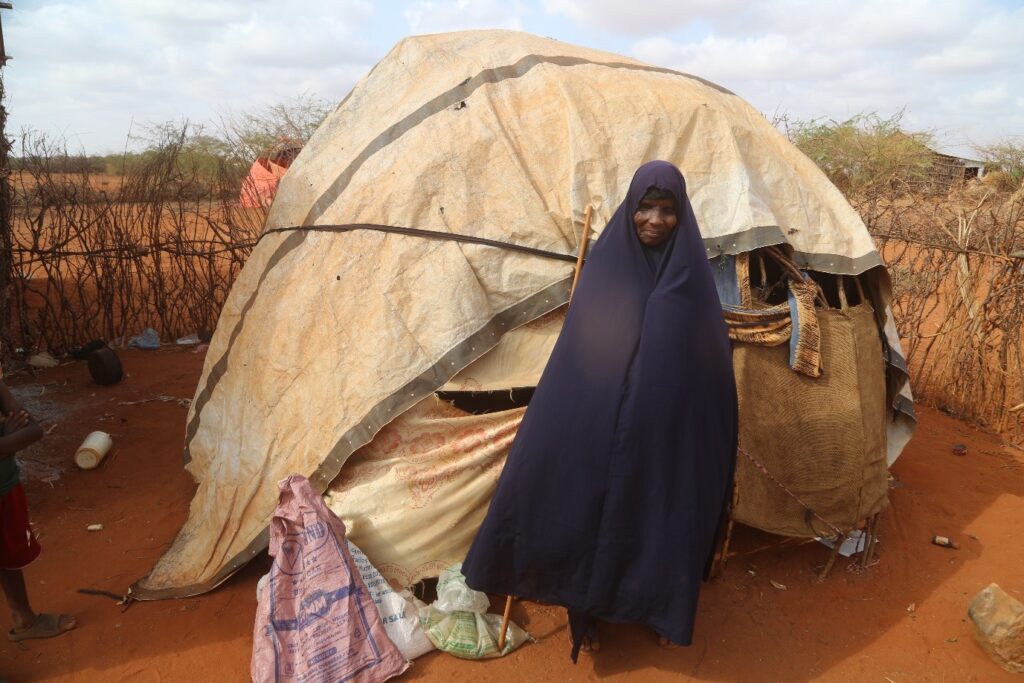
To support Dahabo and 175 other displaced households to improve their food security and reduce dependence on negative coping mechanisms, they have been provided with emergency rapid food assistance through food vouchers in Garas and Tuula Jibriil Villages in Beled Hawa District. These food vouchers have enabled the families to access lifesaving food rations from local vendors. By purchasing food locally, this not only meets the urgent needs of displaced families but also helps stimulate nearby markets that have been severely affected by the ongoing conflict.
With the food vouchers, Dahabo now redeems essential food items from local vendors and ensures her children have enough to eat. For the first time since fleeing her home, she no longer worries about where the next meal will come from. The support has eased her daily struggles, allowing her to focus on finding a source of livelihood for her family in the uncertainty of displacement. For many displaced households, the food vouchers not only meet urgent food needs but also help preserve their limited income for other essentials.
“The food vouchers have really helped us,” Dahabo says softly. “Now I can buy what my children need. It has made life a little easier as I try to start over.”
Nomadic Assistance for Peace and Development (NAPAD)’s food voucher program is designed to support internally displaced persons (IDPs) and other vulnerable groups facing food insecurity. By using vouchers, families like Dahabo’s are able to choose and purchase a variety of food items from local retailers restoring not just their access to food, but also their sense of dignity and choice. This approach also helps stimulate local economies, keeping small businesses active even in times of crisis. The project is implemented by NAPAD with support from German Doctors, ensuring that families in displacement receive both immediate relief and a foundation to rebuild their resilience.
The region continues to face continuous conflict and instability, which has disrupted access to essential services. Thousands are without medical care as a result of attacks on health facilities, while school closures and teacher displacement have deprived children off education. At the same time, the destruction of water and sanitation systems has deepened the risk of acute watery diseases, including cholera, worsening the humanitarian crisis. In the face of these challenges, humanitarian organizations have played a critical role in providing lifesaving support to displaced and vulnerable communities. Yet, much more remains to be done to ensure that assistance reaches those most in need especially minority clans, women, children, the elderly, and persons with disabilities who often bear the greatest burden of the ongoing conflict.